Herbal Wound Healing Oil: What Should You Actually Look For?
When the skin is injured, wound care is about more than simply applying a product and covering the area. The condition of the wound, cleanliness, moisture, dressing material and the stage of healing can all matter.
This is why choosing a wound healing oil should involve more than looking for a product labelled “herbal” or “natural.” It is worth understanding what the formulation contains, what the manufacturer actually claims about it, and how the product is intended to interact with a wound dressing.
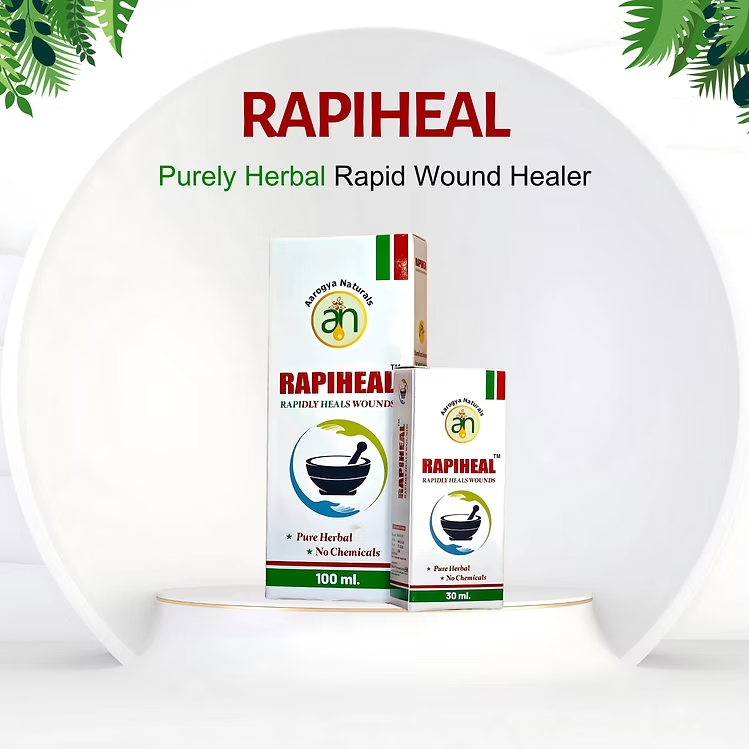
RapiHeal from Aarogya Naturals takes a distinct approach. The company describes it as an all-natural antiseptic and wound-healing oil, prepared using herbs under the supervision of qualified experts and following protocols of modern pharmaceutical sciences.
Rather than presenting RapiHeal as a universal treatment for every type of wound, it is more useful to understand the formulation, its intended role in wound care and the specific product information provided by its manufacturer.
What Is RapiHeal?
RapiHeal is a herbal wound-healing oil developed by Aarogya Naturals.
According to the product information published by Aarogya Naturals, RapiHeal is formulated with a combination of herbs including Betel nut, Karanj, Betel, Kachnar, Guduchi Neem, Curcuma and Glycyrrhiza glabra. The product page states that phytoconstituents and alkaloids present in these herbs have antibacterial, antifungal and antiviral activity.
The formulation also includes herbs listed by Aarogya Naturals for their phytonutrient content, including Rose, Lavender, Karanj, Kachnar, Black Pepper, Chameli, Nirgundi and Nagkesar. The company associates these constituents with processes such as cell growth, collagen synthesis, re-epithelialization and scar contraction.
These statements describe Aarogya Naturals’ formulation rationale and product claims. They should not be interpreted as proof that every ingredient, or RapiHeal as a whole, has been clinically demonstrated to produce each of these effects.
Why Is the Oil Format Relevant to Wound Dressing?
One of the more interesting aspects of RapiHeal is not simply that it is herbal—it is that the product is an oil-based formulation.
Aarogya Naturals states that the oily nature of RapiHeal coats the skin and helps protect it from maceration associated with wet wound soiling. The company also explains that the oil can act as a lubricant between the wound and dressing, potentially reducing the need for anti-stick or paraffin gauze.
This is an important point that is often overlooked when people search for the “best wound healing oil.”
Wound care involves an interaction between the wound, the topical product and the dressing. A topical preparation that works alongside the dressing may offer a different practical experience from a product that is considered only for its ingredients.
For this reason, people researching herbal wound healing oil should consider both the formulation and its intended role in the dressing process.
What Makes RapiHeal Different From a Generic Herbal Oil?
Calling a product “herbal” does not tell you very much by itself.
A meaningful evaluation should look at:
- The ingredients used.
- The manufacturer’s stated purpose.
- How the formulation is intended to be used.
- Whether the product information explains its relationship with wound dressing.
- Whether claims are clearly identified as manufacturer information rather than presented as independent clinical evidence.
RapiHeal provides a relatively specific formulation description.
The product page identifies two broad groups of botanical components: one associated by Aarogya Naturals with antimicrobial activity and another associated with tissue-repair-related processes.
This gives readers more information than a generic “natural wound care” label.
RapiHeal’s Herbal Ingredients
Aarogya Naturals lists the following ingredients on the RapiHeal product page:
Herbs identified for antimicrobial activity
- Betel nut
- Karanj
- Betel
- Kachnar
- Guduchi Neem
- Curcuma
- Glycyrrhiza glabra
According to Aarogya Naturals, phytoconstituents and alkaloids in these herbs have antibacterial, antifungal and antiviral action.
Herbs identified for wound-healing-related phytonutrients
- Rose
- Lavender
- Karanj
- Kachnar
- Black Pepper
- Chameli
- Nirgundi
- Nagkesar
Aarogya Naturals states that phytonutrients from these herbs are associated with cell growth, collagen synthesis, re-epithelialization and scar contraction.
This ingredient transparency is useful for readers who want to understand what is actually inside a natural wound healing oil, rather than relying solely on marketing language.
How Does Wound Healing Work?
Wound healing is a biological process rather than an instant event.
After an injury, the body coordinates several overlapping processes, including inflammation, tissue formation and remodeling. Collagen production and the formation of new tissue are important parts of the repair process.
Research into herbal wound-healing formulations has also explored mechanisms such as antimicrobial activity, antioxidant activity, cell proliferation and wound closure. For example, a peer-reviewed study of a specific herbal oil formulation investigated antimicrobial activity, antioxidant activity, cell proliferation and in-vitro wound closure. Importantly, those findings relate to that particular formulation and should not be transferred automatically to RapiHeal.
This distinction matters.
A scientific study on one herbal formulation is not evidence that another commercially available oil has the same clinical effectiveness. Responsible health content should make that difference clear.
When People Search for a Wound Healing Oil
Searches for terms such as wound healing oil, herbal wound healing oil and Ayurvedic wound healing oil can represent very different needs.
Someone may be looking for:
- Information about caring for a minor wound.
- A topical herbal formulation.
- An oil that can be used with wound dressing.
- Information about the ingredients in a wound-care product.
- An alternative to conventional topical products.
- General information about supporting the wound-healing process.
That means a useful article should not simply declare one product to be the “best.”
Instead, readers should be given enough information to make an informed decision and understand when professional medical advice is appropriate.
RapiHeal and Dressing Care
A particularly notable claim made by Aarogya Naturals concerns wound dressing.
The company states that RapiHeal’s oily nature allows it to act as a lubricating agent between the wound and dressing. According to the manufacturer, this can decrease the need for anti-stick or paraffin gauze.
The product page further states that RapiHeal can reduce the need for antibiotics and anti-adhesive dressings and that the observed healing time is significantly reduced. These are manufacturer statements; the available product page does not provide a clinical trial design, sample size or comparative statistics that would allow those claims to be independently quantified from the page alone.
That transparency is important when evaluating any herbal antiseptic oil or wound-care product.
Is a Herbal Wound Healing Oil Suitable for Every Wound?
No single topical product should automatically be assumed to be appropriate for every wound.
A wound may require professional evaluation depending on its depth, size, location, cause, contamination and other circumstances. Particularly concerning wounds—including deep wounds, heavily contaminated injuries, significant burns, animal or human bites, wounds with spreading redness or swelling, persistent discharge, fever, or wounds that are not healing—should be assessed by an appropriate healthcare professional.
People with conditions that can impair wound healing should also seek professional advice rather than relying solely on a topical product.
A wound healing oil should therefore be considered within an overall wound-care approach, not as a substitute for appropriate medical assessment.
Why Ingredient Transparency Matters
The natural-products market contains a wide range of oils, balms and creams. Yet “herbal” alone does not explain how a product is formulated.
RapiHeal’s product page provides a named ingredient list and explains the manufacturer’s intended rationale behind different groups of herbs.
For consumers, this creates a better starting point for comparison.
Instead of asking only:
“Is this a natural wound healing oil?”
a more useful set of questions is:
“What is in it?”
“What does the manufacturer actually say it is intended to do?”
“How is it intended to be used with wound dressing?”
“Are the claims supported by information that is clearly identified as product information or independent evidence?”
These questions can help consumers make more informed choices.
RapiHeal by Aarogya Naturals: Product Information
Aarogya Naturals currently lists RapiHeal on its website as a purely herbal rapid wound-healing product. The product page displays a 5.0/5 rating based on 12 reviews at the time of review, although customer reviews are user experiences and should not be treated as clinical evidence.
The product page currently lists the price from ₹154, with a displayed sale price of ₹119.97, including taxes. Pricing can change, so readers should verify the current price directly on the manufacturer’s website.
You can view the current product information directly on the RapiHeal product page from Aarogya Naturals. View RapiHeal on Aarogya Naturals
RapiHeal in the Larger Natural-Wound-Care Conversation
Traditional and herbal approaches to wound care have received scientific interest, but evidence needs to be evaluated formulation by formulation.
This is where RapiHeal’s positioning is interesting. It is not simply presented as a traditional Ayurvedic oil; Aarogya Naturals describes its development as combining herbal ingredients with protocols of modern pharmaceutical sciences and states that qualified experts supervise its preparation.
Aarogya Naturals’ broader company story also states that an allopathic orthopedic surgeon, an Ayurvedic physician and an approved Manufacturing Chemist are involved in monitoring product development from research through production.
That background provides useful context for readers evaluating the brand, while still leaving room for independent evidence to be assessed separately.
A Better Way to Choose Wound-Care Products
Whether someone is considering RapiHeal or another Ayurvedic wound healing oil, a sensible evaluation can start with five questions:
- What ingredients are actually listed?
- What is the manufacturer’s intended use?
- Is there information about how the product interacts with wound dressings?
- Which statements are manufacturer claims and which are independently studied findings?
- Does the wound require professional medical assessment?
This approach is more useful than relying on exaggerated phrases such as “instant healing,” “100% guaranteed results” or unsupported claims about treating every type of wound.
Final Thoughts
The search for a wound healing oil should not be reduced to finding the product with the longest ingredient list or the strongest marketing claim.
RapiHeal by Aarogya Naturals offers a specific herbal formulation containing botanicals such as Karanj, Kachnar, Curcuma, Glycyrrhiza glabra, Rose, Lavender, Black Pepper, Nirgundi and Nagkesar. Aarogya Naturals positions the formulation around antiseptic and wound-healing support and highlights the oil’s role in protecting the wound area from wet soiling and providing lubrication between the wound and dressing.
For consumers interested in natural wound care, the most valuable approach is to combine ingredient transparency, realistic expectations and appropriate wound-care guidance.
RapiHeal can be explored directly through Aarogya Naturals for its complete product information and current availability. Explore RapiHeal by Aarogya Naturals
Important Note
This article is intended for general educational purposes. Product descriptions and formulation-related claims are based on information published by Aarogya Naturals and should not be interpreted as independent clinical validation of every stated benefit. A healthcare professional should evaluate serious, deep, infected, persistent or otherwise concerning wounds.