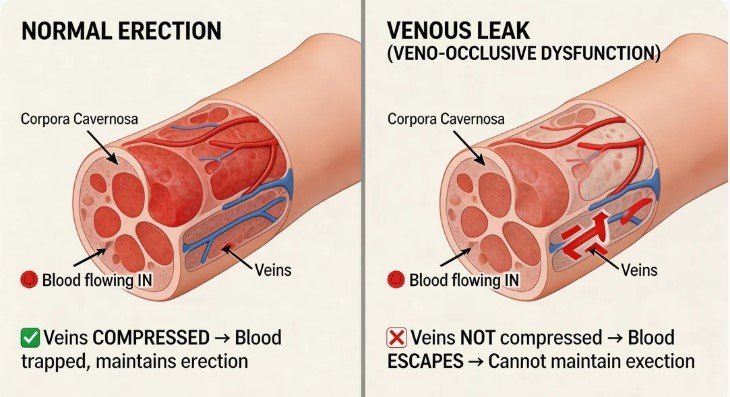
Erectile dysfunction can affect men at any age and may develop for physical, psychological, hormonal, vascular, or medication-related reasons. One condition frequently discussed in connection with difficulty maintaining an erection is venous leak.
The medical term often used for this problem is veno-occlusive erectile dysfunction. It describes inadequate restriction of blood leaving the penis during an erection.
The expression “venous leak” can sound as though a vein has developed a physical hole. In reality, the problem is generally related to the penis not adequately trapping blood within the erectile tissue to maintain rigidity.
Understanding this distinction is important because difficulty keeping an erection does not automatically mean that a man has venous leak. A detailed evaluation is needed to determine the actual cause.
Understanding Venous Leak
An erection depends on a balance between blood entering and leaving the penis.
During sexual stimulation, arteries deliver increased amounts of blood into the erectile tissues. As these tissues expand, pressure within the penis increases and compresses the veins responsible for draining blood away.
This natural mechanism is sometimes called the veno-occlusive mechanism.
When it works properly, blood remains inside the erectile chambers and the penis stays firm.
When this mechanism does not function adequately, blood may leave the erectile tissue too readily. As a result, the erection can gradually become softer.
This is the basic concept behind what is commonly called a venous leak.
Venous Leak Is Not Simply a “Leaking Vein”
The terminology can create unnecessary fear.
In most cases, “venous leak” should not be interpreted as a literal hole in a vein.
The issue concerns how effectively the erectile tissue and surrounding structures restrict venous outflow during erection.
This is why treatment should focus on identifying the underlying erectile dysfunction rather than assuming that a damaged vein must be surgically repaired.
How an Erection Normally Stays Firm
Several systems work together to create and maintain an erection.
Sexual stimulation
The brain and nervous system initiate signals associated with sexual arousal.
Arterial dilation
The penile arteries widen, allowing more blood to enter the erectile tissues.
Expansion of the corpora cavernosa
The erectile chambers fill with blood and expand.
Compression of venous outflow
As pressure rises inside the erectile tissue, the veins become compressed.
Maintenance of rigidity
The reduced blood outflow helps keep the penis firm.
If blood inflow is inadequate, an erection may not develop properly. If blood retention is inadequate, an erection may develop but fail to remain firm.
Both situations can result in erectile dysfunction.
What Are the Symptoms of Venous Leak?
The symptoms usually involve difficulty maintaining erection firmness.
A man may notice that:
- He can initially achieve an erection but cannot keep it
- The penis becomes softer during intercourse
- The erection disappears after penetration
- Continuous stimulation is needed to remain erect
- Erections are less firm than before
- Sexual performance becomes inconsistent
- The erection is lost when stimulation stops
- The problem occurs repeatedly rather than occasionally
Some men may still have satisfactory erections in certain situations.
Symptoms can vary considerably depending on the underlying cause and severity.
Can You Get an Erection With Venous Leak?
Yes.
One of the reasons the condition can be confusing is that a man may be able to achieve an erection but have difficulty maintaining it.
For example, an erection might become firm during initial stimulation and then gradually lose rigidity.
However, this pattern is not specific to venous leak.
Performance anxiety, reduced stimulation, alcohol, medications, hormonal problems, vascular disease, and several other conditions can produce similar symptoms.
What Causes Venous Leak?
There is no single cause in every patient.
Possible contributing factors include conditions that affect erectile tissue, blood vessels, nerves, or overall vascular health.
Penile or Pelvic Trauma
Injury to the penis or pelvic area can potentially affect structures involved in erectile function.
A history of significant trauma is therefore important when assessing ED.
Peyronie’s Disease
Peyronie’s disease causes scar tissue to develop within the penis.
The resulting curvature or structural changes may sometimes be associated with difficulty achieving or maintaining an erection.
Diabetes
Diabetes can affect both blood vessels and nerves.
Over time, poorly controlled blood sugar may contribute to erectile dysfunction through several mechanisms.
Cardiovascular Disease
Healthy arteries are essential for normal erections.
Conditions affecting vascular health may interfere with erectile function and can contribute to ED.
Obesity and Metabolic Problems
Excess body weight and metabolic disorders may be associated with hormonal changes, vascular dysfunction, and inflammation that can contribute to erectile difficulties.
Pelvic Surgery
Some pelvic surgeries can affect nerves, blood vessels, or tissues associated with erection.
The risk depends on the type of surgery and individual circumstances.
Neurological Disorders
The nervous system plays an important role in initiating erections.
Neurological disease or nerve injury can therefore contribute to erectile dysfunction.
Aging
Erectile dysfunction becomes more common as men get older.
This does not mean ED should simply be accepted as unavoidable aging. Age-related vascular changes, medical conditions, medications, and hormonal changes can all contribute.
Lifestyle Factors
Smoking, heavy alcohol consumption, physical inactivity, poor diet, and other unhealthy lifestyle patterns can negatively affect erectile and cardiovascular health.
Venous Leak vs Erectile Dysfunction
Venous leak is not synonymous with erectile dysfunction.
Erectile dysfunction is a broad clinical condition involving difficulty achieving or maintaining an erection suitable for sexual activity.
Veno-occlusive dysfunction is one possible mechanism that can contribute to ED.
Other mechanisms include:
- Poor arterial blood flow
- Nerve dysfunction
- Hormonal abnormalities
- Medication effects
- Psychological factors
- Structural penile conditions
- Multiple factors occurring simultaneously
This distinction is important because treating the wrong cause may produce disappointing results.
How Is Venous Leak Diagnosed?
A diagnosis should not be based solely on symptoms.
The doctor usually begins with a detailed medical and sexual history.
Important questions may include:
- When did the problem begin?
- Did it develop suddenly or gradually?
- Can you achieve an erection?
- How long does it remain firm?
- Do erections occur during sleep or upon waking?
- Are erections possible during masturbation?
- Has sexual desire changed?
- Do you have diabetes?
- Do you have high blood pressure or cholesterol?
- Do you smoke?
- What medications are you taking?
- Have you experienced pelvic or penile trauma?
- Have you undergone pelvic surgery?
- Are stress or relationship problems affecting sexual activity?
A physical examination may also be appropriate.
Penile Doppler Ultrasound for Venous Leak
One of the more specialized tests used in selected cases is penile duplex Doppler ultrasound.
The examination allows a clinician to evaluate blood flow within the penis.
In many protocols, medication is used to produce an erection. Ultrasound measurements can then be taken as the erection develops.
The examination can provide information about:
- Arterial blood inflow
- Erectile response
- Blood-flow patterns
- Possible abnormalities in the veno-occlusive mechanism
The results should be interpreted by an experienced clinician.
A single Doppler value should not be used in isolation to make a diagnosis because erection quality, technique, timing, medication response, and other clinical factors can affect interpretation.
Are Blood Tests Useful?
Blood tests do not directly diagnose venous leak.
However, they can help identify medical conditions that may contribute to ED.
Depending on the patient’s age, symptoms, and medical history, testing may include:
- Blood glucose
- HbA1c
- Lipid profile
- Testosterone
- Thyroid-related tests
- Other hormone investigations when indicated
The exact laboratory assessment should be individualized.
Why Is Proper Diagnosis So Important?
Suppose a man frequently loses his erection during intercourse.
It may be tempting to conclude that he has venous leak.
But the same symptom can occur because of performance anxiety.
Another man may have diabetes-related vascular disease.
Someone else may be experiencing medication-related ED.
Another patient may have a combination of vascular and psychological factors.
These conditions require different approaches.
A proper diagnosis therefore prevents unnecessary treatment and improves the chances of addressing the actual cause.
Treatment Options for Venous Leak
Treatment depends on the individual’s diagnosis.
There is no single therapy that works for every man.
1. Improve Overall Health
A healthy cardiovascular system supports healthy erectile function.
Important measures include:
- Regular physical activity
- Healthy body weight
- Smoking cessation
- Limiting excessive alcohol
- Balanced nutrition
- Good blood-pressure control
- Diabetes management
- Cholesterol management
- Adequate sleep
- Stress management
These measures can be particularly important when ED is associated with vascular risk factors.
2. Oral Erectile Dysfunction Medication
PDE5 inhibitors are commonly prescribed for erectile dysfunction.
Examples include:
- Sildenafil
- Tadalafil
- Vardenafil
- Avanafil
These medications improve the erectile response to sexual stimulation.
They do not physically close or repair a vein.
Nevertheless, some men with vascular or mixed erectile dysfunction can experience meaningful improvement with these medicines.
They are not suitable for everyone, particularly people taking nitrate medications. Medical advice is important before starting them.
3. Vacuum Erection Devices
A vacuum erection device creates negative pressure around the penis.
This helps draw blood into the erectile tissues.
A constriction ring may then be used to help maintain the erection for sexual activity.
Vacuum devices are non-surgical and may be useful for men who cannot take certain medications or who do not respond adequately to them.
4. Penile Injection Therapy
Intracavernosal medication can produce an erection directly within the erectile tissue.
This treatment can be effective for some men with ED.
However, it requires proper instruction because excessive dosing can cause a prolonged erection that requires medical attention.
5. Psychological Treatment
Psychological factors should not be overlooked.
Performance anxiety can cause or worsen erection difficulties.
After repeated episodes of ED, a man may begin anticipating another failure. This anticipation can increase anxiety during sexual activity and interfere with arousal.
Counseling or sex therapy can help address these factors.
Psychological treatment can be useful even when a physical cause is also present.
What About Venous Leak Surgery?
Surgical procedures intended to reduce abnormal penile venous outflow have been used in some settings.
However, their long-term effectiveness has not been consistently demonstrated for all patients.
Therefore, surgery should not automatically be considered the first-line solution.
Before an invasive procedure, a patient should understand:
- The certainty of the diagnosis
- Other possible causes of ED
- Available non-surgical treatments
- Expected benefits
- Possible complications
- Long-term results
Be cautious of claims that venous leak surgery provides a guaranteed permanent cure.
Can Shockwave Therapy Treat Venous Leak?
Low-intensity shockwave therapy has been investigated for erectile dysfunction, particularly vascular-related ED.
Some research suggests potential benefits in selected patients, while questions remain regarding patient selection, treatment protocols, and long-term effectiveness.
It should not be presented as a guaranteed method for repairing venous leakage.
A qualified doctor can explain whether this therapy is appropriate for a particular patient.
Can Venous Leak Be Cured Permanently?
There is no universal answer.
The outlook depends on the underlying cause.
When ED is related to modifiable factors, addressing those factors may improve erectile function.
For example, treating diabetes, stopping smoking, improving cardiovascular health, addressing medication side effects, or treating confirmed hormonal problems may help.
In other cases, ongoing treatment may be required.
The goal should be to achieve reliable sexual function safely rather than focusing solely on the idea of permanently “fixing” a vein.
Can Lifestyle Changes Help?
Lifestyle changes can be an important part of erectile-health management.
Quit Smoking
Smoking damages blood vessels and is associated with erectile dysfunction.
Exercise Regularly
Physical activity supports cardiovascular health and can benefit overall sexual health.
Maintain a Healthy Weight
Weight management may improve metabolic and vascular risk factors associated with ED.
Control Blood Sugar
Good diabetes management can help protect blood vessels and nerves.
Manage Blood Pressure
Long-term high blood pressure can affect vascular function.
Reduce Excessive Alcohol
Heavy alcohol consumption can negatively affect sexual performance and overall health.
Sleep Well
Poor sleep can influence mood, energy, hormones, and sexual function.
Does Testosterone Help?
Testosterone is not a direct treatment for venous leak.
If a man has symptoms of testosterone deficiency and laboratory testing confirms low testosterone, a doctor may consider appropriate treatment.
However, testosterone should not be used simply because a man has ED.
The underlying cause of erectile dysfunction needs to be evaluated first.
Venous Leak and Morning Erections
Morning erections are sometimes used by men as a way to judge whether they have a physical erectile problem.
However, morning erections alone cannot diagnose venous leak.
A man with ED may still occasionally experience morning or nighttime erections.
Conversely, reduced morning erections can have several possible causes.
Doctors look at the broader pattern rather than using morning erections as a stand-alone diagnostic test.
Does Venous Leak Affect Libido?
Venous leak primarily involves erection maintenance.
It does not necessarily reduce sexual desire.
A man can have:
- Normal libido with ED
- Reduced libido with normal erections
- Both low libido and ED
Reduced sexual desire may be associated with stress, depression, relationship problems, hormonal abnormalities, medications, sleep problems, or other medical conditions.
Does Venous Leak Cause Infertility?
Venous leak does not automatically cause infertility.
It primarily concerns erection quality and maintenance.
However, severe ED may make intercourse difficult, which can indirectly interfere with attempts to conceive.
Male fertility is influenced by sperm production, sperm quality, hormones, testicular function, ejaculation, and other factors.
If conception is difficult, a separate fertility evaluation may be appropriate.
Can Anxiety Make Venous Leak Symptoms Worse?
Yes.
Even when a physical factor is present, anxiety can make erection problems more noticeable.
For example:
Physical erection difficulty → fear of losing erection → increased anxiety → reduced arousal → further difficulty maintaining erection.
This cycle can become self-reinforcing.
Addressing anxiety does not mean ignoring possible physical causes. Both may need treatment.
When Should You See a Doctor?
Occasional erection difficulties are common.
However, you should consider professional evaluation if the problem:
- Happens repeatedly
- Continues for several months
- Makes intercourse difficult
- Causes significant distress
- Appears suddenly
- Occurs alongside other health problems
- Develops after an injury
- Is accompanied by penile pain or curvature
- Occurs with reduced libido
- Begins after starting a new medication
Persistent ED deserves attention because it can sometimes be associated with broader cardiovascular or metabolic health concerns.
Which Specialist Treats Venous Leak?
A urologist is usually the appropriate specialist for persistent erectile dysfunction and suspected veno-occlusive dysfunction.
A urologist specializing in male sexual medicine or andrology may be particularly experienced in evaluating complex erectile problems and interpreting specialized penile vascular testing.
Depending on the findings, other healthcare professionals may also be involved.
What Should You Ask Your Doctor?
Consider asking:
- What is the likely cause of my erectile dysfunction?
- Do my symptoms actually indicate veno-occlusive dysfunction?
- Would penile Doppler ultrasound be useful?
- Do I need blood tests?
- Could diabetes or cardiovascular risk factors be contributing?
- Could my medications affect erections?
- Which treatment should I try first?
- Are oral ED medications safe for me?
- Would a vacuum device or injection therapy be appropriate?
- Do I actually need surgery?
- What are the risks of the proposed treatment?
- How will we measure whether treatment is successful?
Frequently Asked Questions
Is venous leak the same as ED?
No. Venous leak is a possible mechanism of erectile dysfunction. ED is a broader condition with many potential causes.
Can venous leak be diagnosed from symptoms alone?
No. Symptoms such as losing an erection can occur for many different reasons.
Is penile Doppler ultrasound accurate?
It can provide useful information about penile vascular function when performed and interpreted appropriately, but results must be considered within the full clinical context.
Can a man with venous leak still have sex?
Yes. The severity of erectile dysfunction varies, and several treatment options may help improve sexual function.
Do Viagra or similar medications repair venous leak?
No. PDE5 inhibitors can improve erectile function in some men, but they do not physically repair the underlying veno-occlusive mechanism.
Is venous leak caused by masturbation?
There is no good medical basis for assuming that normal masturbation causes venous leak.
Does venous leak get worse with age?
Erectile dysfunction becomes more common with age, but the course varies between individuals and depends on underlying health conditions and risk factors.
Can exercise cure venous leak?
Exercise can improve cardiovascular health and may support erectile function, but it should not be described as a guaranteed cure for confirmed veno-occlusive dysfunction.
Is surgery necessary?
Not necessarily. Treatment depends on the cause and severity of ED. Many patients are managed with non-surgical approaches.
Final Thoughts
Venous leak is a commonly used term for a problem involving inadequate blood retention within the penis during an erection. The more precise medical concept is veno-occlusive erectile dysfunction.
The most important point is that difficulty maintaining an erection does not automatically prove venous leak. Similar symptoms can result from vascular disease, diabetes, medications, hormonal abnormalities, neurological conditions, psychological factors, or a combination of causes.
A proper medical assessment can help determine what is actually happening. Depending on the diagnosis, treatment may include lifestyle changes, oral medications, vacuum devices, injection therapy, psychological support, or other options.
If erection problems are persistent or interfering with sexual activity, consulting a qualified urologist or male sexual-health specialist can help identify the underlying cause and establish an appropriate treatment plan.